Show Your ID
To keep a Claude account, Anthropic can now require a government ID and a face scan, and rival labs sit under the same pressure.
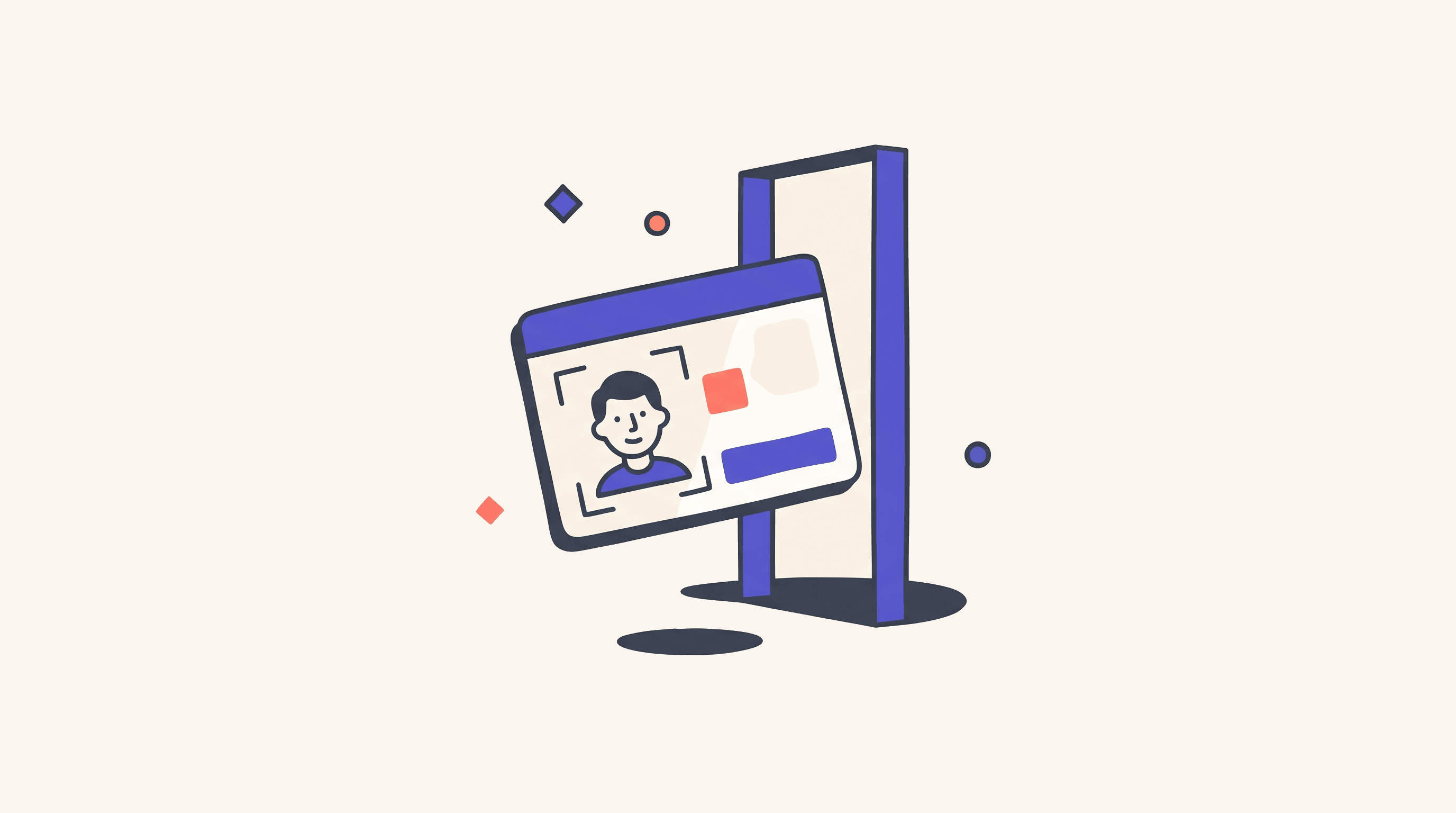
Today, to keep a Claude Free, Pro, or Max account, you may need to hand Anthropic a photo of your driver's license and a video of your face. Anthropic's updated privacy policy takes effect on July 8 with a new data category called "Verification Data," and the label is broader than most readers assume. The scope reaches "an image of a government-issued identity document and all personal information printed on it," plus a face capture, plus what Anthropic itself concedes "may be considered biometric data in some jurisdictions."
The verification runs through Persona Identities, a third-party vendor that stores the ID image and selfie on its own servers. Anthropic ingests a verification result and retains what the policy says it needs, on terms the policy leaves loose. There's no US KYC statute for AI-service access. Anthropic put this in place because the political pressure ran ahead of the law.
KYC arrived at frontier AI without a KYC law. The pressure came from other directions. Export controls tightened, national-security review broadened, and the Fable 5 nineteen-day suspension in June showed every frontier lab what happens when it can't verify who's using its model. Anthropic moved first on the consumer side. OpenAI, Google, and Meta all sit under the same weather, and once one lab requires ID for consumer plans, the others can point at the precedent.
Legislation would have specified who verifies, what gets stored, how long, and what rights users have to delete the biometric data. Provider policy specifies far less than a statute would. The third-party vendor arrangement means the actual biometric handoff happens under Persona's terms, not Anthropic's. If you want to know how long a facial-geometry template of your face is held, that answer lives in Persona's data-retention window, not the policy you're accepting to keep using Claude.
If your product runs through Claude Free, Pro, or Max, the practical concern is verification friction. Users asked for ID may refuse, and their accounts get paused. Production workflows that depend on those users staying signed in start degrading this week. This isn't the kind of provider change that hits enterprise API contracts directly, but it hits the consumer surfaces many operators quietly depend on for internal tooling and small-team production.
Anthropic won't be the last to add this. OpenAI already requires ID verification for developer access to its most capable models under its cyber policy. Google's cloud identity systems can be pointed at consumer AI access whenever the political weather demands. Two years from now, the surprise may not be that Claude requires a face and an ID. It'll be that any frontier model can still be reached without them.
What to Do With This
If you're picking AI tooling as an individual or a small team, read the "Verification Data" section of Anthropic's privacy policy before you accept it. Know that Persona holds the ID image and selfie on its own infrastructure, not Anthropic's. Decide whether the facial-geometry template retention window that Persona publishes is acceptable to you before the verification request appears.
If you lead a team that uses AI across several workflows, check which of your production integrations depend on Free, Pro, or Max Claude sessions where a human user could be prompted to verify. Rotate to enterprise-tier API access for anything that can't tolerate a verification pause. Do the port now, not in the middle of a support ticket.
If you decide what AI tools the whole company runs, add "biometric collection by third-party vendor" to your vendor-risk review for any consumer-tier AI service. This isn't an Anthropic-specific line item but a category one that'll apply to more vendors over the next two quarters.
Want More Than This Newsletter?
Alcreon publishes a daily AI briefing, long-form dossiers, and an analysis feed for the teams actually shipping AI in production. This newsletter is one read out of the full library.
Read the daily feed or browse the editorials.
Also on the Radar
Chinese Open Models Take 30 Percent of US OpenRouter Tokens, Peak 46 Percent
An OpenRouter and a16z analysis that CNBC picked up on July 7 shows Chinese open-source models have held above 30 percent of US enterprise token routing since February 8, peaking at 46 percent, against an 11 percent average over the previous year. The published driver is a 60 to 90 percent price gap between open Chinese models and leading US frontier systems. Teams route the cheap-enough tasks to the cheapest workable model, and the token share follows.
OpenAI Ships Two New Realtime Voice Models, Mini Variant Reasons at a Third the Audio-Token Cost
OpenAI released two new Realtime models on July 6, cutting p95 latency by at least 25 percent across the Realtime voice line through improved caching. The gpt-realtime-2.1-mini variant supports reasoning at $10 audio input and $20 audio output per million tokens, against $32 and $64 for the full model. The updates cover better alphanumeric recognition, cleaner background-noise handling, and sharper interruption behavior, making production voice agents more viable at the mini price point.
Share
Read Next
See all
Echo
Not a Coding Tool
Anthropic's data on 1.2 million Cowork sessions puts coding third at 8.7%, and the agent category quietly became an all-department tool, not engineering's.
Echo
Thirty-One Seconds
JADEPUFFER is the first ransomware run end-to-end by an LLM, and it broke in through Langflow, the same agentic framework class operators deploy.
Echo
Two Markets, One Vendor
Together AI's $800 million Series C confirms open-source inference on neoclouds has become a revenue-scale market running parallel to the closed-frontier labs.