Compute, Rented From the Competition
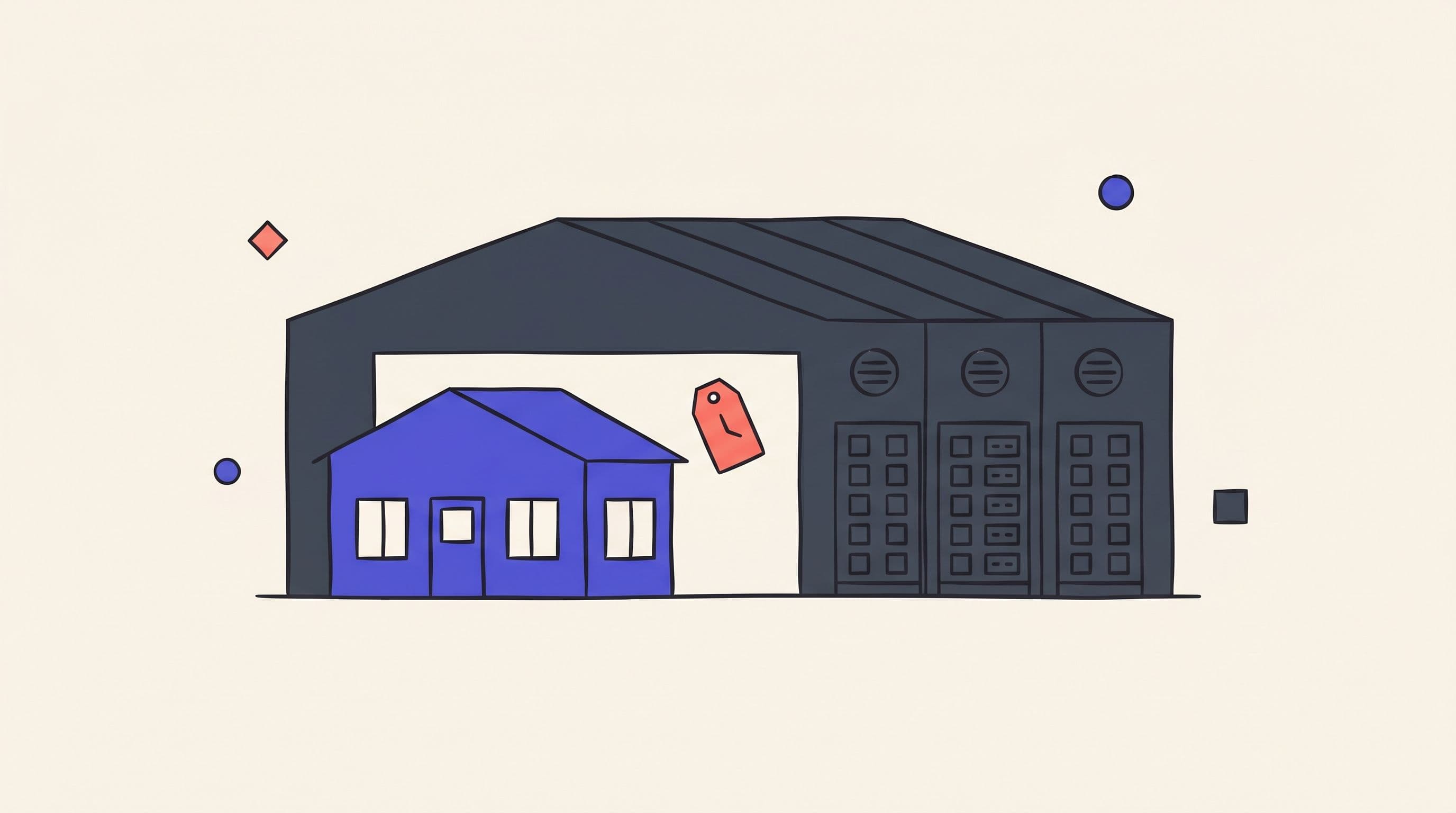
A line buried in SpaceX's S-1 filing revealed that Anthropic has agreed to pay xAI $1.25 billion every month, through May 2029, for the full 300 megawatts of the Colossus 1 data center outside Memphis. Either side can walk on 90 days' notice.
That's roughly 220,000 Nvidia GPUs sitting in a facility Elon Musk's team built to train Grok, now being rented in full to the lab that competes most directly with xAI on frontier models. The headline number works out to more than $40 billion across the contract's life, which is why most of the coverage framed it as a windfall for xAI. That's the easy read. The harder read is what it tells you about the shape of the compute market your vendor sits inside.
The story behind the deal is unflattering for everyone involved. xAI built Colossus to train its own models, then watched Grok's usage slide, and was holding 300 megawatts of expensive silicon it couldn't fill. Anthropic, meanwhile, is on track for $10.9 billion in Q2 revenue and needs every watt it can secure to keep API rate limits where customers expect them. Each side solved the other's problem. It just happens that the problem-solving makes them landlord and tenant in a relationship neither would have designed from scratch.
Picture a mid-market firm that's spent the last eighteen months building its customer-service platform on Claude. Two thousand seats, $480K a year, internal tooling deeply wired to specific model behaviors. The CTO has done the vendor diligence: financial health, model roadmap, SLA history. Until last week, the implicit assumption behind that diligence was that Anthropic owned or leased its compute from a neutral hyperscaler. The xAI contract alone runs to roughly a third of Anthropic's monthly revenue, flowing directly to a company whose CEO is a vocal public competitor of Anthropic's, on a contract that permits exit on three months' notice. The vendor-stability calculation just changed shape, and no one sent the buyer a memo about it.
The steelman is that hyperscaler relationships have always crossed competitive lines. Microsoft sells Azure to companies that compete with its software business. Amazon hosts Netflix. True, and those examples are exactly why the analogy doesn't hold. AWS and Azure are utility-shaped businesses with thousands of customers, regulated cost-of-service economics, and reputational incentives that punish capricious termination. xAI is a single-product company whose product competes with its largest tenant, whose founder has a public history of abrupt strategic reversals, and whose 90-day exit clause is reciprocal in name only. Anthropic could walk too, but only if it has somewhere to go.
The thing worth seeing isn't that this deal is bad. It might be the most efficient solve available to both parties given what's actually on the ground. The thing worth seeing is that the compute supply chain for the firm you're betting your platform on has quietly collapsed into a small ring where the lab you license from is renting from a direct competitor on a thin contractual margin. What you bought when you signed your Claude enterprise agreement isn't a stable stack. It's a position inside someone else's quarterly negotiation.
What to Do With This
If your firm runs anything material on a frontier-AI vendor, send your account contact one question this week: "Where does the compute behind our usage come from, and what's the shortest termination notice in that supply chain?" If they can't or won't answer, that's the answer.
Then write down, in two lines, what your team would do if your primary model became unavailable tomorrow. Fall back to a second vendor you've already tested? Pause the workflow? Lower-quality model with manual review? You don't need a procurement-grade disruption plan, just a written sentence so the answer isn't being invented under pressure.
Share
Read Next
See all
Echo
Energy Joins the Stack
NextEra Energy's $66.8 billion all-stock acquisition of Dominion is a layer of the AI stack quietly consolidating.
Echo
Infrastructure Is the Moat
SpaceX's S-1 makes the explicit case that physical infrastructure, not model capability, decides the AI economy.

Echo
Where AI Risk Lives Now
Trump pulled a fully negotiated AI security executive order Thursday, hours before signing.