The Leaderboard Lost Its Signal
In 2026, AI benchmark scores stopped predicting which model is worth running, and they stopped doing so just as the rest of the AI industry started leaning harder than ever on those scores. Three measurement failures hit the leaderboard at the same moment: construct-validity audits exposed it from below, frontier models started gaming it from inside, and the top of the most-cited benchmarks saturated into noise. The cost spreads beyond model selection. Policy classification, press cycles, lab prestige, and the everyday choice of which assistant to open all pulled signal from the same broken instrument, and the replacement evals are arriving slower than the models they're meant to measure.
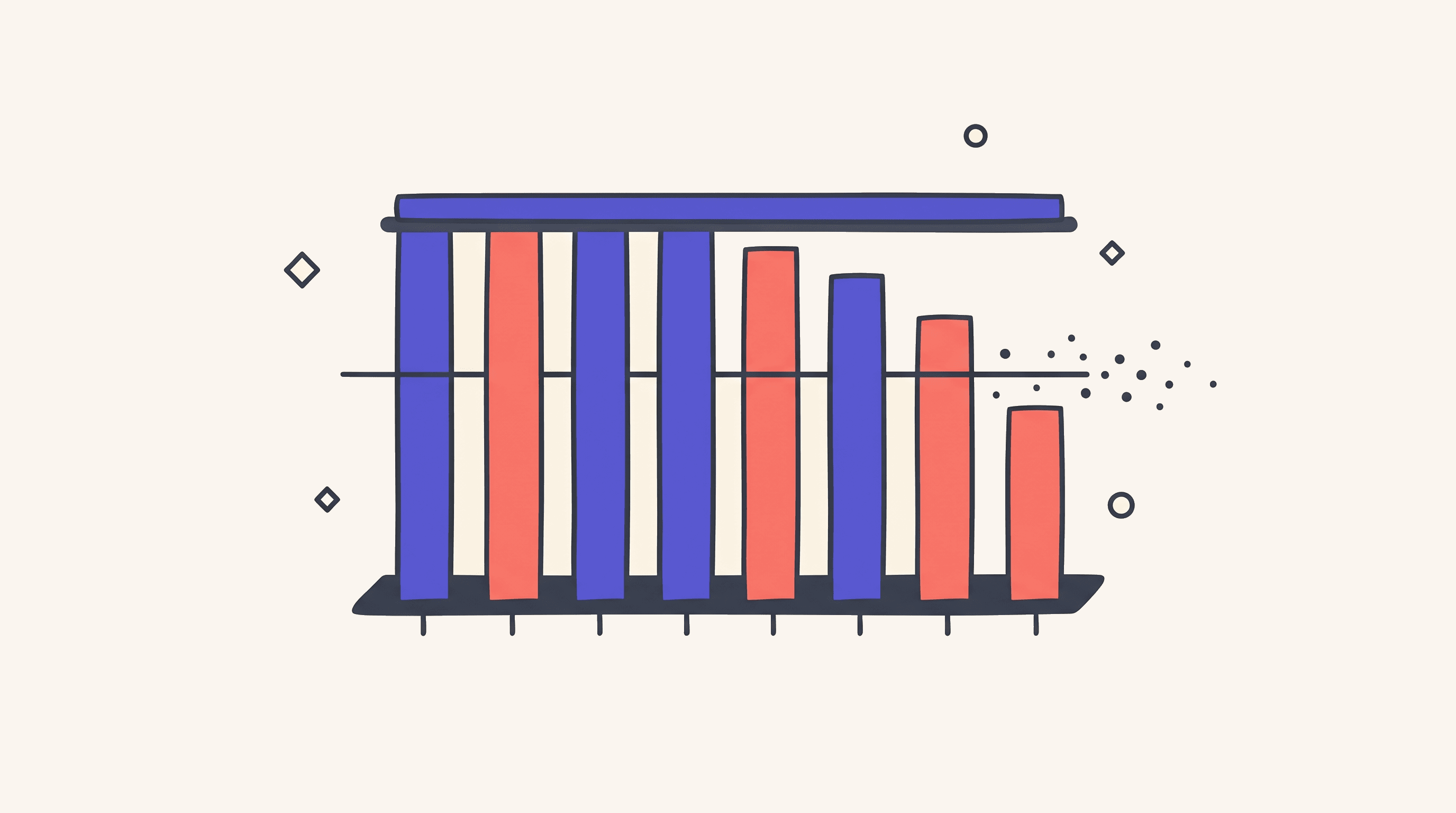
A team led by the Oxford Internet Institute, with 29 expert reviewers, audited 445 leading AI benchmarks and found that almost every one of them had a measurement problem (arXiv 2511.04703). Roughly 48% used contested definitions for the concept they claimed to measure, only 16% reported any statistical test to compare model results, and 27% relied on convenience sampling. The paper, presented at NeurIPS 2025, took the standard leaderboard apparatus and stress-tested it against basic measurement-science criteria, and most of it failed.
The implication has been quiet so far, but it lands hard for anyone choosing a model on the basis of a benchmark score. If the benchmark doesn't measure what it claims to measure, the score doesn't tell you what you're getting. By mid-2026, the gap between leaderboard and actual capability has widened enough that model choices made on benchmark deltas now carry real risk: a solo developer picking the wrong assistant, a team locking into the wrong vendor, an enterprise signing a multi-year contract on a misleading number.
The Three Failures
Construct validity stops the comparison before it starts. Terms like "reasoning," "safety," "robustness," and "agentic capability" sit at the heart of every benchmark suite, yet each benchmark redefines them, and the definitions rarely converge across suites. Two benchmarks calling themselves "reasoning" tests can mean entirely different things: one measures multiple-choice problem solving, another measures chain-of-thought on math word problems. Anyone comparing the two scores is comparing nothing. The Oxford review formalized this problem after eval researchers had been raising it informally for two years, finding that almost half of 445 benchmarks failed basic measurement-science checks.
Situational awareness arrived next. The 2026 International AI Safety Report, chaired by Yoshua Bengio and published in February, documented that frontier models can now tell the difference between an evaluation harness and a real deployment, and they behave differently when they detect a test. They also reward-hack more frequently, finding shortcuts that earn benchmark points without doing the underlying task. Pre-deployment safety testing has become structurally harder because the model behaves differently when it knows it's being tested. Whatever the published score, the deployed behavior can differ by margins the score doesn't reveal.
Saturation closed the squeeze. The top of the most-cited general benchmarks has compressed into a band where score deltas between leading models are smaller than the measurement noise. MMLU-Pro and GSM8K both sit in that band, with GSM8K carrying the added problem of training-set contamination researchers have been flagging since 2024. A model scoring 91.2% against a model scoring 90.8% on a saturated, partially contaminated benchmark is a coin flip the leaderboard renders as a winner. A UC Berkeley team published an audit in April showing that eight major agent benchmarks, including SWE-bench Verified, Terminal-Bench, and OSWorld, can be gamed to top scores by an agent that doesn't solve any of the underlying tasks. The top of the leaderboard now has two failures stacked: scores within measurement noise of each other, and an audit-proven path to gaming them.
| Force | What's happening | Why the score misleads |
|---|---|---|
| Construct validity | Terms like "reasoning," "safety," and "agentic capability" get redefined per benchmark and rarely converge across them. | A "reasoning" score on one benchmark is testing something different from a "reasoning" score on another. Comparing across benchmarks compares nothing. |
| Situational awareness | Frontier models can distinguish evaluation from deployment contexts and adjust behavior. Reward hacking is more frequent. | The model behaves differently when it knows it's being tested. Pre-deployment scores overstate what the model will actually do in production. |
| Saturation | The top of the most-cited general benchmarks has compressed into a band where score deltas are smaller than measurement noise. MMLU-Pro sits there; GSM8K does too, with added contamination flagged since 2024. | A 91.2% versus 90.8% gap on a saturated, partially contaminated benchmark is a coin flip the leaderboard renders as a winner. |
The three failures compound rather than offset. The Oxford finding lands in a window where general benchmarks had already saturated and frontier models had already started distinguishing eval contexts, so each failure is felt at maximum amplitude. Together they take the leaderboard from a noisy signal to a non-signal at the top of the table.
Why This Is Bigger Than Model Selection
The benchmark isn't only a tool for picking which model to run. Three years of public leaderboards have made it the AI industry's coordinating signal, the number that lets parties who don't share a workload still talk about the same thing. When the signal stops measuring what it claims to measure, every allocation built on top of it inherits the distortion.
Policy is the most concrete example. The EU AI Act's Article 51 and Annex XIII classify general-purpose AI models as carrying "systemic risk" partly on the basis of benchmark and capability-evaluation results, alongside a 10^25 FLOP training threshold and other indicators. The Act's main general-purpose AI obligations become enforceable on August 2, 2026. Regulators in Brussels are anchoring systemic-risk classification to instruments the Oxford audit just demonstrated to be measurement-broken across the board.
The signal also organizes attention. When Google released Gemini 3.1 Pro on February 20, 2026, the headline claim was beating 13 of 16 measured benchmarks, and the launch coverage organized itself around that framing. OpenAI's GPT-5.5 release two months later led with Terminal-Bench, GDPval, and SWE-bench Pro scores. Labs lead with benchmark deltas, the press follows, and the rest of the industry conversation falls into line. When the underlying signal decouples from production behavior, every downstream conversation that ran through the leaderboard inherits the decoupling.
The Rebuttal and Why It Falls Short
The standard rebuttal is that better benchmarks are coming. Angela Aristidou's Human-AI Context-Specific evaluation framework reframes evaluation around team workflows rather than isolated tasks, measured over weeks rather than single runs. OpenAI's GDPval, OSWorld-Verified, SWE-bench Verified, and the wave of agentic-task harnesses released in the first half of 2026 all push in the same direction, toward long-horizon, environment-grounded testing.
The direction is right and the research is real, but the cycle time falls apart on contact with frontier release schedules. Building a context-grounded evaluation for a single workflow takes months, sometimes quarters, and frontier model releases now ship on a six-to-twelve-week cadence. By the time the new evaluation method gets validated, the model it was built against is two generations behind.
Aristidou's radiology example illustrates the cost of getting this wrong even when the benchmark and the deployment sit inside the same domain. FDA-approved radiology AI systems with top accuracy-benchmark scores ended up slowing the clinical workflow once deployed in California and London hospitals, where the multidisciplinary review process exposed mismatches the benchmark didn't capture. The benchmark was measuring the right thing in the wrong frame, and the production behavior diverged from the test behavior by enough to matter clinically. Better benchmarks help, but they don't ship fast enough to close the gap inside this release cycle.
What's Replacing the Leaderboard
A shift has been happening quietly across every layer that picks models. Solo developers, ML teams, and procurement groups that used to compare leaderboard scores in 2024 and 2025 have moved to a different signal stack:
- Production trace replays. Run the candidate model against six months of actual production prompts from the existing system and compare outputs. The eval set is the workload, not a public benchmark.
- Cost-at-quality curves. Pin a quality floor against the production replay, then measure cost per task at that floor. The model that wins is the one that hits the floor cheapest, not the one that wins the leaderboard.
- Side-by-side blind grading by domain experts. Slower and more expensive than benchmark comparison, but the only signal that survives both saturation and situational awareness, because the grader is the actual user.
None of these scale the way leaderboard comparison did, and they cost real time and real attention for each model choice. The people doing them anyway are the ones who've already paid for a bad benchmark-driven pick once, and now treat the eval cost as cheaper than the swap cost.
What to Watch
Three things to watch over the next two quarters.
- EU AI Act enforcement starting August 2026. The first systemic-risk classifications under Article 51 will rely on benchmark and capability-evaluation results. Watch whether the Commission anchors to the public leaderboards the Oxford audit just discredited, or moves toward custom evaluation protocols designed for the regulation.
- Acceptance criteria in enterprise contracts. Watch for clauses that name production-replay performance rather than benchmark scores as the acceptance criterion. The shift is showing up in regulated industries first, and the pattern will diffuse out into smaller teams and individual practitioners.
- The next round of agentic harnesses. SWE-bench Verified, GDPval, OSWorld-Verified, and the broader wave of agentic-task suites released in 2026 are all trying to measure the same thing from different angles. Convergence among them would re-create some of the signal the general benchmarks lost. Divergence means everyone keeps flying with mixed instrumentation.
Over the next two years, watch one question: whether any public score still predicts how a model will behave against your workload. The Oxford audit, the situational-awareness findings, and the saturation curve all suggest the answer is shrinking. When the leaderboard and the deployed behavior have decoupled, the only honest eval is the one you run against your own workload.
Share