Three Bets On AI Support
Fin, Decagon, and Sierra are pitched at the same buyer and solving three different problems. A reference comparison of what each is actually for.
The bet each vendor is making
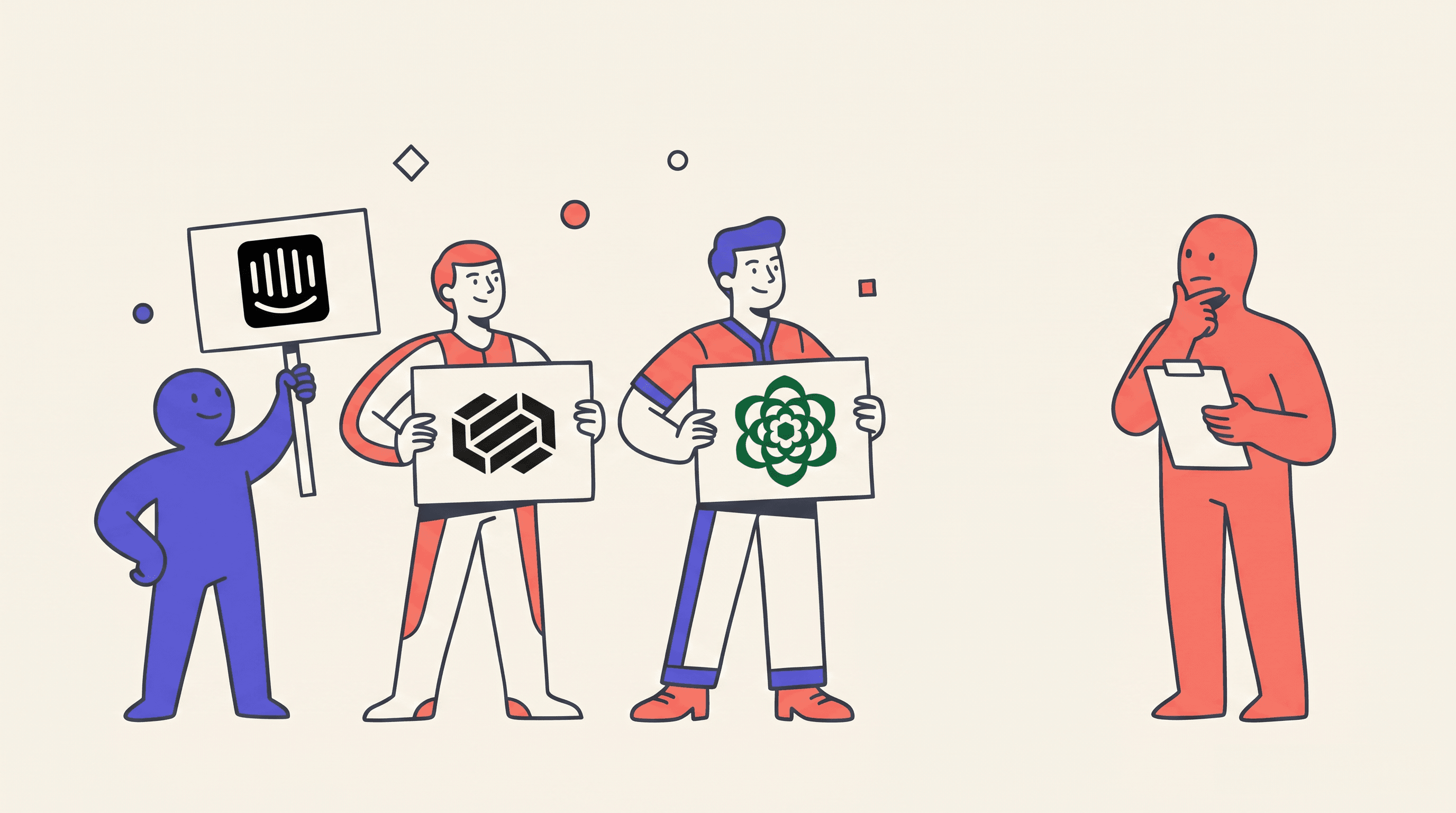
Three vendors are pitched at the same buyer, and they are running three different theories of what AI in customer support is actually for. The question feels new because the products feel new. In the first half of 2026 alone, Intercom shipped Procedures and Fin for Sales, Decagon expanded its Agent Operating Procedures, and Sierra matured its voice stack. The category is splitting fast enough that a buyer working from last year's research is buying last year's product.
Intercom Fin treats AI customer support as a deflection tool. Its job is to answer most tickets without a human, with the help center as the source of truth. The bet is that most tickets are repetitive and answerable, and that what the buyer needs first is fast time-to-value and predictable cost. Pricing is public and per-outcome. The trial is self-serve. Setup runs in days. The math is clean at low volume and gets expensive at scale.
Decagon treats AI customer support as a workflow tool. Its job is not just to answer questions but to act on them: identity checks, refund eligibility, subscription changes, shipment exceptions. The bet is that the hard part of support is the multi-step decision across systems, and that the right unit of value is a procedure, not a reply. Pricing is opaque. Implementation is sales-led and engineering-supported. Capability is high, and what it costs to get it running is high alongside it.
Sierra treats AI customer support as part of the brand. Its job is to sound like the company, remember the customer, and never embarrass either. The bet is that for premium consumer brands, an AI agent that gets the tone wrong is worse than one that escalates. Pricing is custom and outcome-based. Implementation is enterprise-shaped. The voice product is the most developed of the three.
These are not three flavors of the same product. They are three different theories of what 2026's AI support agent should be. The risk in the buying process is choosing the wrong category, not the wrong vendor.
Pick Fin if you need to ship in two weeks
The right buyer is an upper-SMB or lean mid-market team with a help center that is mostly current, repetitive ticket types like order status and password resets, and no appetite for a six-month implementation.
The pricing math is the cleanest of the three. Fin charges $0.99 per resolved outcome, which means 1,000 outcomes a month cost $990, 5,000 cost about $4,950, and 10,000 cost $9,900 before helpdesk seats. Above 5,000 to 10,000 outcomes a month, the math is high enough that a contract negotiation pays for itself. Below that, the public rate is simpler than any enterprise quote.
What Fin shipped in the first half of 2026 is meaningful. Procedures for multi-step workflows arrived with versioning, simulations, and failure reporting. Fin for Sales is the clearest pre-purchase agent extension among the three. Monitors with AI Scoring give ongoing quality checks. The product is moving fast.
Where Fin gets weaker is anything that depends on context outside the help center, complex multi-system exception handling, or voice as a self-serve product. Voice is still gated to an account-manager conversation.
Pick Fin when getting started fast matters more than handling the messy edge cases. Skip it for support that depends on policy discretion or for actions across systems that have not already been cleanly modeled.
Pick Decagon if "answering" is a small part of your support
The right buyer is a high-volume support team with repeatable but complex procedures: identity checks, refund eligibility, subscription changes, shipment exceptions, account actions, device troubleshooting, policy-bound exception handling. The kind of work where the answer is not a paragraph but a series of correct decisions across systems.
Decagon's strongest claim is its Agent Operating Procedures, which it abbreviates to AOPs. AOPs combine plain-language instructions with code-backed execution, identity verification, refund logic, guardrails, versioning, testing, and root cause analysis when something fails. Fin calls similar work Procedures and is catching up. Sierra calls related work Skills inside its developer SDK. Of the three, Decagon's public material is the most concrete on the procedural side, and its integrations list is the deepest: Salesforce, Zendesk, Intercom, Confluence, Kustomer, Amazon Connect, RingCentral, plus protocol-level support for technical teams.
Where Decagon is weak is in transparency. There is no public list price. Pricing is per-conversation or per-resolution, and the definitions of "conversation" and "resolution" matter at scale. You cannot model them from the website. The product is also younger than Fin's, and reviews through 2025 noted that some of the maturity around audit logs, regression checks, and guardrails was still developing. Those gaps have been closing fast, but they are worth checking before signing.
Pick Decagon when ticket volume is high enough to justify a vendor-led implementation and when the team has the patience to maintain the procedures that follow. Skip it if the real goal is a quick bot launch on a thin help center.
Pick Sierra if a bad AI answer would damage the brand
The right buyer is a consumer company with high customer lifetime value, premium service expectations, or heavy phone volume: travel, financial services, premium ecommerce, membership businesses, telecom, and healthcare-adjacent service. Any brand where one viral screenshot of an AI saying the wrong thing creates a real problem.
The reason to pick Sierra is brand control. The product gives you composable Skills that wrap goals and guardrails, voice with sentiment detection and tone adaptation, memory for relationship continuity, and observability through a tool called Insights. The voice product is the strongest of the three: low-latency speech, the ability to handle interruptions and background noise, accent recognition, sentiment cues, and support for more than 55 languages.
Where Sierra is publicly weak is comparability. There are fewer published reviews than for Fin and less product-operating detail than for Decagon. There is no public list price, and outcome-based pricing only works cleanly when business value is unambiguous, like a saved cancellation or a qualified lead. It gets dangerous when "outcomes" can hide silent abandonment or weak handoffs. Implementation is enterprise-shaped.
Pick Sierra when brand control, voice quality, and customer continuity are worth what it takes to set up. Skip it if the only reason is to cut support cost. The platform is built around brand voice and customer relationship; cost reduction comes second.
When none of the three fits
If support volume is under 300 tickets a month, all three are too much. The cheaper path is to improve the help center, use whatever AI is already built into your existing helpdesk, or look at a smaller specialized vendor. The consulting budget is better spent rewriting documentation than evaluating enterprise contracts.
If the work is regulated (legal advice, clinical decisions, regulated financial guidance, high-risk eligibility), full automation is the wrong starting point. Begin with draft assistance, retrieval, and human approval. The escalation rates that vendors quote do not exist in regulated workflows.
Self-hosted retrieval setups (often called RAG) and open-source agent frameworks become an option only when the company has engineering ownership, strict data constraints, or unusual workflow logic that vendor tools cannot handle. Open source is not cheaper if nobody owns evaluations, monitoring, escalation, and ongoing maintenance. Most teams underestimate that cost and discover it after a year of internal tooling debt.
How the three compare
The cells map real choices: pricing transparency, integration depth, voice maturity, evaluation rigor. Each row is a question a buyer is already asking.
| Criterion | Intercom Fin | Decagon | Sierra |
|---|---|---|---|
| Setup time | Self-serve trial, public pricing, sub-hour platform setup claims. | Sales-led; ROI in weeks, but assumes workflow design and Agent Operating Procedure (AOP) authoring. | Sales-led; brand-led implementation with Skills, voice, channels, data access. |
| Procedural automation | Procedures: branching logic, code, simulations, failure reporting, versioning. | Agent Operating Procedures: instructions plus code execution, refunds, guardrails, testing, root cause analysis. | Skills inside the Agent SDK; less public detail on procedural QA and rollback. |
| Voice and multilingual | Fin Voice exists, gated to Sales; not self-serve yet. | Public language covers chat, email, voice, SMS, custom surfaces, any language. | Strongest voice claim: low-latency, interruptions, background noise, accents, sentiment, 55+ languages. |
| Sales and pre-purchase | Fin for Sales: discovery, qualification, meeting booking, sales handoff. Clearest packaging of the three. | Proactive agents and outbound voice exist; center of gravity remains support automation. | Strong commerce and retention fit; less cleanly packaged as a sales agent. |
| Integrations | Standard coverage: Intercom, Salesforce, HubSpot, Freshworks, Zendesk articles. | Strongest public depth: Salesforce, Zendesk, Intercom, Confluence, Kustomer, Amazon Connect, RingCentral, protocol-level. | Strong through SDK; less buyer-friendly named-integration detail. |
| Eval and observability | Improving fast: simulations, monitors, custom scorecards, AI scoring, review queue. | Strongest QA story: simulations, traces, evaluation, unit testing, A/B testing, root cause analysis, automated optimization. | Insights for analytics, experimentation, observability, monitoring, alerting. |
| Pricing transparency | $0.99 per outcome. Predictable at small volume. Renegotiate above 5,000 to 10,000 monthly outcomes. | No public list price. Per-conversation or per-resolution. Impossible to compare without contract terms. | No public list price. Outcome-based, custom. Best if outcomes map to clear business value. |
| Implementation model | Lowest dependency. Self-serve to start, grow into more. | Vendor partnership and ongoing iteration. | CX design, voice, tone, memory, data integration. |
What to test during a demo
These are the fifteen tickets a buyer should run against each AI support agent in a demo. They cover the failure modes that are easy to skip in a sales pitch: regulated decisions, multi-step workflows, ambiguous intent, knowledge-base gaps, escalation judgment, and brand-sensitive moments. A vendor that handles all fifteen is rare; a vendor that flinches at the same scenarios its competitors handle is the signal to act on.
- Refund request requiring policy lookup, order-history check, and escalation when the customer is outside the refund window.
- Multi-issue ticket combining billing confusion, product setup, and cancellation intent.
- Out-of-scope question that should be escalated, not answered.
- Ambiguous account-history question where the answer depends on CRM or order-system state.
- High-emotion complaint with churn risk, angry language, and refund pressure.
- Warranty exception where policy and customer loyalty conflict.
- Address-change request for an order already in fulfillment.
- Subscription downgrade with retention-offer eligibility.
- Product recommendation before purchase, including handoff to sales.
- Multilingual support request mixing English and Spanish.
- Voice call with interruption, background noise, and a customer who changes intent mid-call.
- PII-heavy ticket where the agent must avoid exposing sensitive data.
- Knowledge-base gap where the agent should say it does not know and route correctly.
- Repeated-contact customer whose prior case history changes the right response.
- Fraud-risk request where the agent must refuse action and escalate.
What to validate before signing
For regulated workflows (legal, clinical, insurance, lending, financial advice), treat this comparison as a starting point only. Each vendor's compliance posture (SOC 2, data processing agreements, regional data residency, HIPAA, model retention) should be confirmed separately during procurement.
Pricing reflects public information. Fin publishes list rates. Decagon and Sierra negotiate, so enterprise discounts, minimum commits, implementation fees, overage rules, and channel-specific pricing should be confirmed in the sales conversation before any commitment.
Vendors release frequently. Re-check the relevant changelogs in the week of the buying decision.
Picking the wrong vendor inside the right category is something you can recover from. Picking the wrong category is much harder to undo.
Methodology
The comparison draws on each vendor's pricing page, product documentation, public product update logs, and third-party reviews on G2, all current as of April 28, 2026. The evaluation rubric covers nine dimensions: setup speed, knowledge handling, escalation quality, procedural automation, voice and multilingual support, sales extensions, integration depth, evaluation tooling, and pricing scalability. Where a vendor does not publish list pricing, this piece says so plainly rather than estimating. Where vendor materials are thin or recent, that is noted at the row level in the matrix. The next iteration will be a hands-on benchmark, running at least 25 tickets per platform against the same knowledge base, the same refund and escalation policy, and the same connected systems. It will score correctness, escalation judgment, source use, tone, action safety, latency, observability, and cost per completed outcome.
Sources
- Intercom, Intercom turns 10, founding background
- Intercom, Fin 2 announcement
- Intercom pricing page
- Intercom, Fin for platforms
- Intercom Fin updates
- Intercom, Fin Procedures explained
- Intercom, deploy Fin AI Agent over phone
- G2, Fin by Intercom reviews
- Decagon, Series A announcement
- Decagon, pricing AI agents
- Decagon product overview
- Decagon, Agent Operating Procedures
- Decagon integrations
- Decagon, automatic optimization
- G2, Decagon reviews
- Sierra About
- Sierra product overview
- Sierra, outcome-based pricing for AI agents
- Sierra Voice
- G2, Sierra reviews
Tools Mentioned
- Intercom Fin — AI customer support agent priced per-outcome at $0.99, with Procedures, simulations, AI Scoring, and Fin for SalesIntercom
- Decagon — Workflow-oriented AI support platform with Agent Operating Procedures, Agent Versioning, Watchtower, and Root Cause AnalysisDecagon
- Sierra — Brand-led AI support with Insights, Agent Traces, and a mature voice stackSierra
Share